Identity, Culture, and Chinese Foreign Policy by Kangkyu Lee
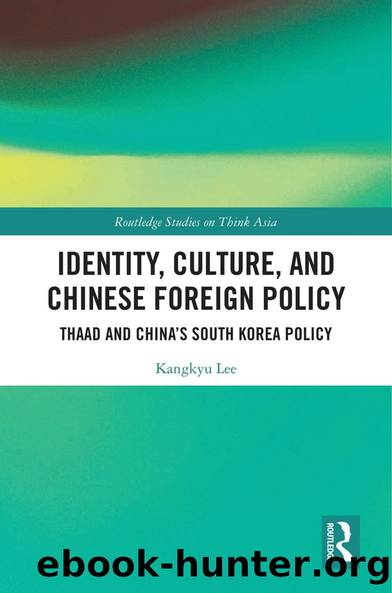
Author:Kangkyu Lee [Lee, Kangkyu]
Language: eng
Format: epub
Tags: Political Science, International Relations, Diplomacy, Security (National & International), Social Science, Ethnic Studies, General, Regional Studies
ISBN: 9781000261431
Google: lBMHEAAAQBAJ
Publisher: Routledge
Published: 2020-11-29T01:00:28+00:00
Back to normal
The âbest period,â however, soon came to an end. All along, the THAAD issue â their unresolved source of conflict â had been simmering. First, the relations went back to normal, and later worsened.
The THAAD deployment became the focus of attention after June 3, 2014, when General Curtis M. Scaparrotti, commander of United States Forces Korea (USFK) and head of the U.N. Command, made remarks about the system at a breakfast meeting of the National Defense Forum, organized by the Korea Institute for Defense Analyses (KIDA), which is the only security think tank under the Ministry of National Defense of the ROK. General Scaparrotti said, âI recommended the deployment of the THAAD missiles to South Korea,â adding, âunlike recent media reports claiming that a preliminary study is currently underway, it would be more accurate to say that an initial review is being conductedâ (Park 2014b).
Although it was the first time the U.S. military had publicly announced that it was considering deploying the THAAD system in South Korea, the issue was raised a few years ago during the nomination hearings of two predecessors of General Scaparrotti. In 2008, at his nomination hearing, the USFK Commander nominee General Walter L. Sharp suggested that the development of THAAD could be crucial âto provide the layered, systematic missile defense capability required to protect critical United States facilities in the Republic of Koreaâ (Sankaran and Fearey 2017, 325). Following General Sharp, General James D. Thurman at his nomination hearing in 2011 as USFK Commander testified that âa THAAD system could be used to provide layered defense and also improve early warning for the Korean Peninsula as well as enhance BMD early warning in the regionâ (Sankaran and Fearey 2017, 325).
However, THAAD had not been seriously discussed until the Park government took power, because South Korea had been building its own missile defense system, known as Korea Air and Missile Defense (KAMD).7 But the THAAD issue resurfaced due to North Koreaâs missile provocations. As North Korea advanced its missile and nuclear capabilities, concerns began to grow that the KAMD could not effectively defend South Korea. For example, on June 20, 2014, South Korean Defense Ministry Spokesperson Kim Min-seok said in a press briefing that âthe current Patriot missile defense system (PAC-3) in Korea is incapable of intercepting the improved version of North Koreaâs Rodong missile, which flew at an altitude of about 160 km in a recent drillâ (Hwang 2014).
Download
This site does not store any files on its server. We only index and link to content provided by other sites. Please contact the content providers to delete copyright contents if any and email us, we'll remove relevant links or contents immediately.
| Arms Control | Diplomacy |
| Security | Trades & Tariffs |
| Treaties | African |
| Asian | Australian & Oceanian |
| Canadian | Caribbean & Latin American |
| European | Middle Eastern |
| Russian & Former Soviet Union |
The Secret History by Donna Tartt(19088)
The Social Justice Warrior Handbook by Lisa De Pasquale(12190)
Thirteen Reasons Why by Jay Asher(8910)
This Is How You Lose Her by Junot Diaz(6887)
Weapons of Math Destruction by Cathy O'Neil(6280)
Zero to One by Peter Thiel(5802)
Beartown by Fredrik Backman(5754)
The Myth of the Strong Leader by Archie Brown(5507)
The Fire Next Time by James Baldwin(5446)
How Democracies Die by Steven Levitsky & Daniel Ziblatt(5219)
Promise Me, Dad by Joe Biden(5153)
Stone's Rules by Roger Stone(5088)
A Higher Loyalty: Truth, Lies, and Leadership by James Comey(4964)
100 Deadly Skills by Clint Emerson(4925)
Rise and Kill First by Ronen Bergman(4789)
Secrecy World by Jake Bernstein(4753)
The David Icke Guide to the Global Conspiracy (and how to end it) by David Icke(4720)
The Farm by Tom Rob Smith(4513)
The Doomsday Machine by Daniel Ellsberg(4490)
